Forgive the terrible name. It is 1am, and I have composed this entire guide in one long unbroken run. I am slightly delirious, but if this gets ANYONE playing CS it'll be worth it.
Anyway. Enough out-of-character ranting. The final chapter will give a quick run-down on the characters you can play as in Blazblue, simple descriptions of their drives and playstyles, and characters from Street Fighter who resemble their playstyle. This will hopefully help you choose who you try to play as when you pick up the game. Note that I'm not including the secret character Mu-12, or the two DLC characters Makoto and Valkenhayn; given you have to unlock and pay for them respectively, it's probably just as well they're left out unless the scene grows serious. So, without further ado, let's get started.
Ragna the Bloodedge
The game's main character, Ragna is a rushdown character with great-ranged normals and excellent combo ability. His Drive, Soul Eater, allows him to perform powerful attacks with the D button, and regain small amounts of health every time one of these moves connects. Play with Ragna typically involves hitting with one of his great normals to start pressure, then pressing the enemy relentlessly with hard hitting combos. If the table is turned, though, Ragna has some of the worst defense in the game.
Try if you like: Balrog, possibly Ryu because he has an uppercut.
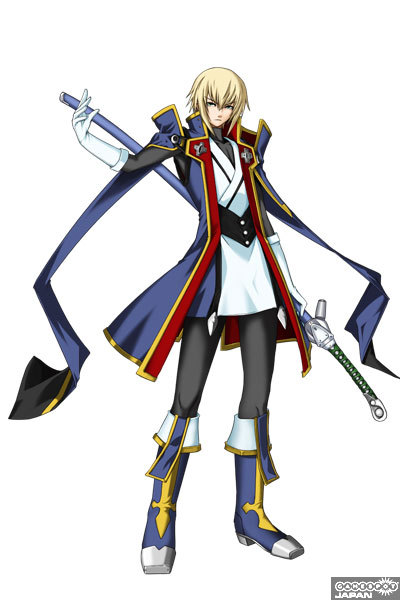
Jin Kisaragi
Ragna's brother and rival, Jin is the closest thing Blazblue has to a Ryu clone. His Drive is Frost Bite, allowing him to freeze enemies with his Drive moves and combo them afterwards. He can also perform Drive versions of his specials for 25 points of gauge, like EX moves in SFIV.
Jin's good pressure and mixup make him an all-rounder, comfortable in all areas but lacking in specialties.
Try if you like: Ryu, not having to learn new specials
Noel Vermillion
The game's main heroine, Noel wields two massive pistols in combat. Her Chain Revolver drive allows her to perform dangerous combos and mixups, but most of these are unsafe if punished correctly. She has to work hard to get her damage, but when she gets it it's heavily rewarding.
Play if you like: Difficult to find a comparison, but in terms of difficulty comboing Guy comes to mind.
Rachel Alucard
An enigmatic vampire, Rachel's playstyle involves setting traps for the opponent and forcing them to keep their distance unless she wants to apply pressure. Her Drive, Sylpheed, allows her to manipulate the wind, either sending herself flying forward or back to maintain control of distance.
Rachel used to be one of the highest tier characters in Calamity Trigger, but is now generally accepted as the weakest. She can still win - it's just very, very hard with her low damage output and requires incredibly precise play.
Play if you like: Testament from GG. There's really no Street Fighter equivalent.
Taokaka
Taokaka is the jumping-around-all-over-the-place character. Her drive is the Dancing Edge, which lets her fly around in all directions. Tao is also the only character who can use her taunt effectively, in a high-level combo known as the taunt loop which does excellent damage but has only a few ways to combo into.
Play if you like: Vega, inducing aneurysms in opponents because you WON'T STAY STILL GODDAMMIT
Iron Tager
As you may guess from the fact he is so FREAKING HUGE, Tager is the game's grappler character. The Voltic Battler drive allows him to magnetise opponents, pulling them in to his attacks and effectively making his range even longer.
Tager is undoubtedly one of the highest tier characters in the game, but has difficulty dealing with characters who can attack from a distance like Hazama and Litchi.
Play if you like: Zangief, Hakan, Mike Z
[This video also gives you a chance to see how America sees this game. I can't say I expect Glasgow to ever have this sort of scene, but it would be pretty damn awesome.]
Litchi Faye Ling
Besides having undoubtedly the largest rack of the series, Litchi's game is all about incredible normals, corner pressure and wakeup hijinks. Her Drive is the staff Mantenbo, which she can control with her mind and use to improve her range and send flying across the stage on her behalf. Litchi is execution intensive, even by Blazblue's standards, but the pressure and damage she can produce are well worth it.
Play if you like: Chun-Li, or any other other well-endowed Chinese women.
Arakune
Arakune's rough on the eye, and rougher on the opponent. His combos typically don't do much damage, but his game plan revolves around his drive, Crimson; if he hits with enough of his Drive moves, his opponent is cursed, and he can unleash all sorts of horrible combos and mixups on the opponent. 8000 damage combos are common if Arakune can land a good curse combo, so the main game for his opponent is to avoid getting cursed no matter what.
Play if you like: No real Street Fighter equivalent, but play if you like the look on your opponent's face when he realises he's about to get utterly wrecked. Also, you'd better have the exec to go with that.
Bang Shishigami
Bang is exactly what he looks like - a ninja with a giant nail. He has great rushdown and okizeme, and his Burning Heart drive allows him to super-armour through enemy attacks and start combos if used correctly. He is also so THOROUGHLY HOT-BLOODED that he can bring his theme song into the game if he activates a super.
Play if you like: Rushdown, being top-tier, SCREAMING AT THE TOP OF YOUR LUNGS.
Carl Clover
Yes, he's about 12 years old, but Carl is still a force to be reckoned with. The Automaton lets him control his 'sister', the robot Nirvana, to fight alongside him. Carl has the hardest execution in the game, basically needing you to control two characters at the same time, but if you can space your opponent right, it'll earn you incredible mixups and combos. Without his sister at his side, though, Carl struggles to fight on his own.
Play if you like: Challenging yourself with difficult combos.
Hakumen
A mysterious warrior with an unknown past, Hakumen wields a massive sword to smite his enemies. His Drive is the God Slash, allowing him to counter oncoming attacks and punish with extreme prejudice. Combined with his incredible pokes Hakumen is a force to be reckoned with, but he is a bit on the slow side.
Play if you like: Sagat, Gouken
λ-11 [Lambda-11]
Though not as blatantly overpowered as her CT counterpart Nu, Lambda is still a dangerous opponent. The Sword Summoner drive does exactly what it sounds like and sends blades hurtling through the air towards the opponent. She is good at keeping opponents out and under control, but if they manage to overcome her assault and approach she's less able to defend herself.
Play if you like: Guile, or turtling in general.
Tsubaki Yayoi
Tsubaki's playstyle is almost paradoxical. On one hand, her close-up combos and pressure are excellent, but on the other she needs to keep her distance from the opponent and charge her Install Gauge to use her drive abilities for the truly damaging combos. Playing Tsubaki requires the player to carefully choose between these two priorities.
Play if you like: Cody, Makoto
Hazama
Hazama's playstyle is potentially devastating. At full range his Ouroboros drive allows him to attack from anywhere on screen, and at close range he can mixup and combo usefully as well. He also has one arguably the best reversal super in the game, beating out almost everything and leading to huge damage. At mid-range, though, Hazama struggles.
Play if you like: LONG-DISTANCE RUSHDOWN, being a troll, Michael Jackson.
So, you've picked a character you want to try playing. Now what?
Well, first of all, Continuum Shift has an inbuilt Challenge Mode similar to SFIV's, allowing you to learn and practice combos until you've got them down. For more in-depth information, better combos, and general help, the best English source is almost definitely DustLoop.
Well, that's about it. That's all I've got to offer on Blazblue: Continuum Shift. Hopefully this guide managed to promote at least some hype - if not, then no-one can say I didn't damn well try.
So long, folks. Stay free, and praise the Hype Dog.
Thursday, 13 January 2011
Step 4: Baby Don't Hurt Me
So, punching folks in the face is good and all, but it's important to know how to defend yourself when the going gets tough too. This chapter will teach you to check yourself before you wreck yourself. First off, let's assume you've been naughty and tried to go on without us, and you're now lying a broken, bleeding mass on the floor. You'd better start getting back up.
Recovery
Street Fighter gives two options for recovery - stand up fast, or don't stand up fast. Blazblue's options are more varied.
Firstly, you can recover in the air. Pressing A B or C and optionally a direction will allow you to escape, assuming your opponent doesn't or can't continue their combo. 4 sends you backwards in the air, 6 sends you forwards, no input means you leap up slightly before you come down. Use to escape blue combos.
Secondly, some moves allow you to quick-rise the moment you hit the ground if you hit A B or C. Like in Street Fighter, these recoveries are invincible.
Sometimes, though, you'll just find yourself prone on the floor. It's not safe to stay down like in SF - your opponent can combo you off the ground and beat you senseless some more, so it's key to get up in the right way.
Your options are rolling forward or backward (4/6 plus a button) which moves you forward/back but is punishable, a neutral roll (A/B/C, no direction) which is invulnerable and puts you back where you fell and a quick-wake-up (2/Down plus a button) which is the fastest wakeup but is also punishable.
Blocking
SF fans will know exactly what I'm about to say - hold 4 [back] to block while being attacked. Hold 1 [down-back] to block low.
Like in Street Fighter, attacks can be one of three types - high, mid, and low. High and mid attacks can be blocked while standing, but lows will hit. While crouch blocking lows will be blocked and highs can whiff, but mids [aka overheads] will hit. Also, jumping attacks will hit crouchers.
Instant Blocking
Tired of waiting for a few frames to react after blocking an attack? Want your attack to come out just a little bit faster so you can punish a move you otherwise couldn't?
Good news! Blazblue comes with a unique system called Instant Blocking that lets you do just that!
If you block just before an attack hits you, your character will momentarily flash white. This shows you've managed to Instant Block, and means you'll recover from blockstun a few frames sooner than normal. Used effectively, Instant Block cuts down your opponent's attack options and forces them to play much safer on their offense.
Barrier Blocking
Still not quite happy with your defense? Wish you could make a prayer and have your opponent knocked back a little from their attacks?
GOOD NEWS! Blazblue's Barrier Blocking is the answer to your prayers!
To Barrier Block, hold A and B while blocking. Do it right, and a green barrier should appear in front of your character. If your opponent attacks you while doing this, they will be knocked back slightly, making it harder for them to perform pressure.
However, Barrier Block comes at a cost. The Barrier Gauge [see the HUD in Step 1] depletes while you hold A and B. If it ever empties, not only will you be unable to Barrier Block but you'll be put in a Danger State, meaning every attack that hits you will do 50% more damage than usual. Obviously this is really really really bad, so avoid it.
The Barrier Gauge refills with time, as long as you don't use it to block.
Guard Primers
Something that may distress Street Fighter players when they play Blazblue is the idea that guarding isn't invincible. Blocks can be broken in this game. How do you know how close you are to guard break? Look at your Guard Primers.
The Guard Primers are the yellow marks next to the timer [look at the HUD if you've forgotten]. Every character starts with a different amount - for example, Hazama has 4 and Tager has 10. The more you have, the harder it is for an opponent to guard break you.
Every character has certain moves that remove a guard primer from their opponent if blocked. These are typically moves that kill off the attacker's pressure, so guard break is something that you have to work for.
If a character is ever reduced to 0 guard primers, their guard is broken. If they're standing, they'll stand in place vulnerable for a few seconds - if they're in the air, they'll be slammed into the wall behind them and fall, easily comboed. They then regain their primers. Primers slowly recover with time, as long as you don't lose any more while they're recovering.
If you're down to one primer, you can prevent being guard broken using Barrier Block, but this will take off large amounts of your Barrier Gauge. If that depletes, then you end up both guard broken AND in the Danger State, which is basically a recipe for a lost round. Avoid this at all costs.
Counter Assault
Sometimes you just don't want to take the risk of letting your opponent come close. This is when the Counter Assault comes into play - press 6A+B just after you've blocked an attack, and you'll knock your opponent away and return the fight to a neutral state.
Counter Assaults cost 50 points of your distortion gauge.
Bursts
When all else fails, when you're on the brink of death, when you look absolutely screwed, bursts are your get-out-of-jail free card. There are two kinds - green and gold. Both are performed by pressing A, B, C and D at the same time.
Green bursts can be performed while blocking or even while being hit. They knock the opponent away forcefully, returning the situation to neutral. They can, however, be baited, so they are not invincible.
As an added penalty, if you use a green burst, your guard primers are halved for the remainder of the round, leaving you more prone to guard breaks. Green bursts are therefore best kept for last-ditch escapes when you're about to die.
Gold bursts are performed at neutral state - not attacking or blocking. If they hit, the opponent is knocked into the air, and can easily be comboed on the way down.
Your bursts are extremely limited. At most, you have 2 to use in an entire match, and you can only use the second if you lose a round. [So in Round 1, you can use 1 burst. If you lose, you can burst twice in Round 2, assuming you haven't used the first one already.] Don't waste them, and they might just be enough to pull your ass out of the fire.
In terms of the gameplay mechanics, that's just about it for Blazblue. Assuming you've managed to take all of that in, there's only one important question to ask - which character are you supposed to play as? The final chapter will cover the various characters of Blazblue, and hopefully give a good idea as to who would suit your playing style.
Recovery
Street Fighter gives two options for recovery - stand up fast, or don't stand up fast. Blazblue's options are more varied.
Firstly, you can recover in the air. Pressing A B or C and optionally a direction will allow you to escape, assuming your opponent doesn't or can't continue their combo. 4 sends you backwards in the air, 6 sends you forwards, no input means you leap up slightly before you come down. Use to escape blue combos.
Secondly, some moves allow you to quick-rise the moment you hit the ground if you hit A B or C. Like in Street Fighter, these recoveries are invincible.
Sometimes, though, you'll just find yourself prone on the floor. It's not safe to stay down like in SF - your opponent can combo you off the ground and beat you senseless some more, so it's key to get up in the right way.
Your options are rolling forward or backward (4/6 plus a button) which moves you forward/back but is punishable, a neutral roll (A/B/C, no direction) which is invulnerable and puts you back where you fell and a quick-wake-up (2/Down plus a button) which is the fastest wakeup but is also punishable.
Blocking
SF fans will know exactly what I'm about to say - hold 4 [back] to block while being attacked. Hold 1 [down-back] to block low.
Like in Street Fighter, attacks can be one of three types - high, mid, and low. High and mid attacks can be blocked while standing, but lows will hit. While crouch blocking lows will be blocked and highs can whiff, but mids [aka overheads] will hit. Also, jumping attacks will hit crouchers.
Instant Blocking
Tired of waiting for a few frames to react after blocking an attack? Want your attack to come out just a little bit faster so you can punish a move you otherwise couldn't?
Good news! Blazblue comes with a unique system called Instant Blocking that lets you do just that!
If you block just before an attack hits you, your character will momentarily flash white. This shows you've managed to Instant Block, and means you'll recover from blockstun a few frames sooner than normal. Used effectively, Instant Block cuts down your opponent's attack options and forces them to play much safer on their offense.
Barrier Blocking
Still not quite happy with your defense? Wish you could make a prayer and have your opponent knocked back a little from their attacks?
GOOD NEWS! Blazblue's Barrier Blocking is the answer to your prayers!
To Barrier Block, hold A and B while blocking. Do it right, and a green barrier should appear in front of your character. If your opponent attacks you while doing this, they will be knocked back slightly, making it harder for them to perform pressure.
However, Barrier Block comes at a cost. The Barrier Gauge [see the HUD in Step 1] depletes while you hold A and B. If it ever empties, not only will you be unable to Barrier Block but you'll be put in a Danger State, meaning every attack that hits you will do 50% more damage than usual. Obviously this is really really really bad, so avoid it.
The Barrier Gauge refills with time, as long as you don't use it to block.
Guard Primers
Something that may distress Street Fighter players when they play Blazblue is the idea that guarding isn't invincible. Blocks can be broken in this game. How do you know how close you are to guard break? Look at your Guard Primers.
The Guard Primers are the yellow marks next to the timer [look at the HUD if you've forgotten]. Every character starts with a different amount - for example, Hazama has 4 and Tager has 10. The more you have, the harder it is for an opponent to guard break you.
Every character has certain moves that remove a guard primer from their opponent if blocked. These are typically moves that kill off the attacker's pressure, so guard break is something that you have to work for.
If a character is ever reduced to 0 guard primers, their guard is broken. If they're standing, they'll stand in place vulnerable for a few seconds - if they're in the air, they'll be slammed into the wall behind them and fall, easily comboed. They then regain their primers. Primers slowly recover with time, as long as you don't lose any more while they're recovering.
If you're down to one primer, you can prevent being guard broken using Barrier Block, but this will take off large amounts of your Barrier Gauge. If that depletes, then you end up both guard broken AND in the Danger State, which is basically a recipe for a lost round. Avoid this at all costs.
Counter Assault
Sometimes you just don't want to take the risk of letting your opponent come close. This is when the Counter Assault comes into play - press 6A+B just after you've blocked an attack, and you'll knock your opponent away and return the fight to a neutral state.
Counter Assaults cost 50 points of your distortion gauge.
Bursts
When all else fails, when you're on the brink of death, when you look absolutely screwed, bursts are your get-out-of-jail free card. There are two kinds - green and gold. Both are performed by pressing A, B, C and D at the same time.
Green bursts can be performed while blocking or even while being hit. They knock the opponent away forcefully, returning the situation to neutral. They can, however, be baited, so they are not invincible.
As an added penalty, if you use a green burst, your guard primers are halved for the remainder of the round, leaving you more prone to guard breaks. Green bursts are therefore best kept for last-ditch escapes when you're about to die.
Gold bursts are performed at neutral state - not attacking or blocking. If they hit, the opponent is knocked into the air, and can easily be comboed on the way down.
Your bursts are extremely limited. At most, you have 2 to use in an entire match, and you can only use the second if you lose a round. [So in Round 1, you can use 1 burst. If you lose, you can burst twice in Round 2, assuming you haven't used the first one already.] Don't waste them, and they might just be enough to pull your ass out of the fire.
In terms of the gameplay mechanics, that's just about it for Blazblue. Assuming you've managed to take all of that in, there's only one important question to ask - which character are you supposed to play as? The final chapter will cover the various characters of Blazblue, and hopefully give a good idea as to who would suit your playing style.
Step 3: Beating Things Up
Now, onto the basics of Blazblue combat. For this example, we'll examine the moves of the closest thing the game has to a shoto - Jin Kisaragi.
[Yeah, I wish I had an outfit as cool as that too. I also wish I could freeze people on command, but a man can dream.]
Normal Attacks
Pressing A, B or C will produce standard attacks such as jabs, kicks and slashes depending on the character. Holding different directions produces different moves - for example, Jin's 5A is a standing jab, while his 2A (down + A) is a crouching jab that hits low.
The moves produced by various directions vary with characters. Experiment and make sure you know everything your character can do so you know how to attack and punish.
Special Moves
Again, if you've seen Street Fighter, you probably know how specials work. Even better, Jin's a great example because his specials are almost identical to Ryu's - 236 produces a projectile, 623 produces an uppercut, 214 is a move that sends him flying forward, and so on. Again, different characters have different moves, so experiment and learn.
[As a note, Charge Moves are typically rather rare in Blazblue, only being used in the super-rare-and-impractical Astral Finishes.]
Throwing
Throws, like in Street Fighter, are used to attack at close range and get around an opponent's guard. They're performed by pressing B and C at the same time. There are two throw types - forward throws, performed with just B+C, and back throws, performed with 4B+C. Unlike Street Fighter, it is possible - and outright expected - for players to be able to combo from their throws, allowing a single throw to produce massive amounts of damage depending on the character.
Throw Escaping
[This might be defense, but I'll throw it in here since I'm talking about throws.]
If an opponent throws you, a green '!' will appear over your character's head. After this, you have a short time to press B+C and tech the throw - roughly 17 frames, or 0.3 seconds of game time. This is roughly the same time as human reaction, making these legitimate throws hard to beat unless predicted.
If you attempt to mash throw escapes in a brain-dead fashion, rather than being rewarded for your sloppiness [sup, SFIV!] you will get what's called a Throw Reject Miss. Basically, this means you have no chance of escaping and the throw will hit you no matter what you do. Stop mashing, cry moar, etc.
You can also throw during hit or blockstun - points where you would normally miss if you tried to throw in Street Fighter. However, this is a considerably different throw in that rather than the green !, a purple '!!' appears over the target's head instead. These purple throws are much, much easier to escape from, with the target getting almost half a second to respond. [Command grabs performed during hit/blockstun will also produce purple throws, and can be escaped from when normally it would be impossible.]
Counters
If you hit an opponent while he's attacking, you'll perform a counter. This will leave the opponent stunned for slightly longer, allowing for more damaging combos. Throws can also work as counters.
On top of this, if you perform a counter with certain character-specific moves [like Jin's 2C] then you get what's called a Fatal Counter. This means the opponent is stunned for longer not just for the next hit, but for every following hit in the combo. This allows for combos that would otherwise be impossible.
Negative Penalty
Blazblue does not approve of cowardice. If you spend too long not attacking, red lines will appear around your character and you'll be told about a Negative Warning. Continue to do nothing, and you'll get a Negative Penalty - any attack that hits you in this state does 50% extra damage. Wuss.
Combos
The combo system works differently in BB than Street Fighter. Rather than systems like juggle points to determine whether moves connect, the simple rule is 'you get less time to combo the further in the combo goes'. This stops you repeating moves repeatedly for easy infinites.
It's easy to produce simple combos in Blazblue - Jin can input A then B then C and it will combo. However, longer and more powerful combos require precise inputs, and use of several abilities that only appear in Blazblue. These techniques are:
Dash Cancelling
Think of dash cancelling as a free Focus-Attack-Dash-Cancel in Blazblue. After performing certain moves - in Jin's case, 6C - you can quickly input 66 and cancel your attack into a forward dash. [Note that this is a dash in the standard Street Fighter style, not a Blazblue run.] This can both help to lengthen combos, and allows you to maintain pressure when otherwise you would be knocked away.
Jump Cancelling
Other moves - Jin's 5C, for example - can be cancelled into a jump instead. This allows you to continue pressure with overheads and continue combos in the air.
Rapid Cancelling
Now, Rapid Cancels are more like FADCs in that they cost half of your meter, but return you to a neutral state mid-attack. They're performed by pressing A, B and C at the same time. For example, let's assume I was playing Jin and tried to fool an opponent with my 623C uppercut and got blocked. Instead of sitting there like an idiot and eating a full combo, I can Rapid Cancel to return to a normal state and start blocking before payback comes.
Rapid Cancels cost 50 points of your Distortion Gauge.
Distortion Drives
These are the super moves of Blazblue. Ranging from 236236 (double quarter circle forward) motions to 720 degree spins, they basically have better damage than most normal moves. One thing to note, though, is that they are not invincible and safe like many of Street Fighter's supers - it's easy to get knocked out of them if performed at a bad time.
Distortion Drives also cost 50 points of your Distortion Gauge.
Astral Finishes
Lastly, there are the Astral Finishes. These are basically finishing moves, again unique to each character. The rules for using them are very strict:
- You must be 1 round away from winning the match.
- You must have a full Distortion Gauge of 100 points.
- Your opponent must be below 1/3 of their health.
- You must have one usable Burst [covered in the Defense chapter].
If you fulfill all these conditions, you can perform an Astral Finish. If you connect with it, you immediately win the match and get a pretty cool animation to go with it. 8)
Well, in terms of offensive options, that's all Blazblue has to offer. Of course, you aren't the only one who's going to be pummeling seven hells out of someone, which leads to the next chapter - defense!
[Yeah, I wish I had an outfit as cool as that too. I also wish I could freeze people on command, but a man can dream.]
Normal Attacks
Pressing A, B or C will produce standard attacks such as jabs, kicks and slashes depending on the character. Holding different directions produces different moves - for example, Jin's 5A is a standing jab, while his 2A (down + A) is a crouching jab that hits low.
The moves produced by various directions vary with characters. Experiment and make sure you know everything your character can do so you know how to attack and punish.
Special Moves
Again, if you've seen Street Fighter, you probably know how specials work. Even better, Jin's a great example because his specials are almost identical to Ryu's - 236 produces a projectile, 623 produces an uppercut, 214 is a move that sends him flying forward, and so on. Again, different characters have different moves, so experiment and learn.
[As a note, Charge Moves are typically rather rare in Blazblue, only being used in the super-rare-and-impractical Astral Finishes.]
Throwing
Throws, like in Street Fighter, are used to attack at close range and get around an opponent's guard. They're performed by pressing B and C at the same time. There are two throw types - forward throws, performed with just B+C, and back throws, performed with 4B+C. Unlike Street Fighter, it is possible - and outright expected - for players to be able to combo from their throws, allowing a single throw to produce massive amounts of damage depending on the character.
Throw Escaping
[This might be defense, but I'll throw it in here since I'm talking about throws.]
If an opponent throws you, a green '!' will appear over your character's head. After this, you have a short time to press B+C and tech the throw - roughly 17 frames, or 0.3 seconds of game time. This is roughly the same time as human reaction, making these legitimate throws hard to beat unless predicted.
If you attempt to mash throw escapes in a brain-dead fashion, rather than being rewarded for your sloppiness [sup, SFIV!] you will get what's called a Throw Reject Miss. Basically, this means you have no chance of escaping and the throw will hit you no matter what you do. Stop mashing, cry moar, etc.
You can also throw during hit or blockstun - points where you would normally miss if you tried to throw in Street Fighter. However, this is a considerably different throw in that rather than the green !, a purple '!!' appears over the target's head instead. These purple throws are much, much easier to escape from, with the target getting almost half a second to respond. [Command grabs performed during hit/blockstun will also produce purple throws, and can be escaped from when normally it would be impossible.]
Counters
If you hit an opponent while he's attacking, you'll perform a counter. This will leave the opponent stunned for slightly longer, allowing for more damaging combos. Throws can also work as counters.
On top of this, if you perform a counter with certain character-specific moves [like Jin's 2C] then you get what's called a Fatal Counter. This means the opponent is stunned for longer not just for the next hit, but for every following hit in the combo. This allows for combos that would otherwise be impossible.
Negative Penalty
Blazblue does not approve of cowardice. If you spend too long not attacking, red lines will appear around your character and you'll be told about a Negative Warning. Continue to do nothing, and you'll get a Negative Penalty - any attack that hits you in this state does 50% extra damage. Wuss.
Combos
The combo system works differently in BB than Street Fighter. Rather than systems like juggle points to determine whether moves connect, the simple rule is 'you get less time to combo the further in the combo goes'. This stops you repeating moves repeatedly for easy infinites.
It's easy to produce simple combos in Blazblue - Jin can input A then B then C and it will combo. However, longer and more powerful combos require precise inputs, and use of several abilities that only appear in Blazblue. These techniques are:
Dash Cancelling
Think of dash cancelling as a free Focus-Attack-Dash-Cancel in Blazblue. After performing certain moves - in Jin's case, 6C - you can quickly input 66 and cancel your attack into a forward dash. [Note that this is a dash in the standard Street Fighter style, not a Blazblue run.] This can both help to lengthen combos, and allows you to maintain pressure when otherwise you would be knocked away.
Jump Cancelling
Other moves - Jin's 5C, for example - can be cancelled into a jump instead. This allows you to continue pressure with overheads and continue combos in the air.
Rapid Cancelling
Now, Rapid Cancels are more like FADCs in that they cost half of your meter, but return you to a neutral state mid-attack. They're performed by pressing A, B and C at the same time. For example, let's assume I was playing Jin and tried to fool an opponent with my 623C uppercut and got blocked. Instead of sitting there like an idiot and eating a full combo, I can Rapid Cancel to return to a normal state and start blocking before payback comes.
Rapid Cancels cost 50 points of your Distortion Gauge.
Distortion Drives
These are the super moves of Blazblue. Ranging from 236236 (double quarter circle forward) motions to 720 degree spins, they basically have better damage than most normal moves. One thing to note, though, is that they are not invincible and safe like many of Street Fighter's supers - it's easy to get knocked out of them if performed at a bad time.
Distortion Drives also cost 50 points of your Distortion Gauge.
Astral Finishes
Lastly, there are the Astral Finishes. These are basically finishing moves, again unique to each character. The rules for using them are very strict:
- You must be 1 round away from winning the match.
- You must have a full Distortion Gauge of 100 points.
- Your opponent must be below 1/3 of their health.
- You must have one usable Burst [covered in the Defense chapter].
If you fulfill all these conditions, you can perform an Astral Finish. If you connect with it, you immediately win the match and get a pretty cool animation to go with it. 8)
Well, in terms of offensive options, that's all Blazblue has to offer. Of course, you aren't the only one who's going to be pummeling seven hells out of someone, which leads to the next chapter - defense!
Step 2: Baby Steps
NOTE: To describe input in this game, I'll be using the standard Japanese notation of input, where each direction is represented by a number:
7 8 9
4 5 6
1 2 3
These directions are given assuming the player is facing right. So, pressing 6 would move forward, 4 would move backward, 236 is a fireball motion, 623 is a dragon-punch motion, and so on.
If a direction is in bold, that means you hold the stick in that direction.
On top of this, Blazblue has 4 buttons:
A = Light
B = Medium
C = Strong
D = Drive
A, B, and C are pretty easy to figure out, but Drive moves are wildly different depending on the character. For example, Ragna gets his life draining moves, Jin gets his freezing moves, Bang gets his counters, and so on. We'll leave going into detail on characters' specific drives for later.
[There is also a Taunt button, but besides one extremely character-specific use it serves no real purpose. We'll ignore that until it arises.]
-----
Movement
One of the biggest differences between Street Fighter and Blazblue is the way they handle movement. While in Street Fighter your movement abilities are basically limited to 'walk, dash, jump', there's a large variety of potential movement options in Blazblue. Here's a rundown on what's available to you.
Walking
Walking is more or less as it is in Street Fighter. Hold 6 [forward] to walk forwards, and 4 [backwards] to walk backwards. Hardly ground breaking stuff. Note also that walk speeds are typically much slower than in Street Fighter. That's because Blazblue focuses much more on...
Running
Pressing 66 - that is, tapping forward twice and then holding forward - will cause your character to run across the screen. This is a much different system from Street Fighter, in that unlike SF you aren't forced to dash a certain distance. You can run for as long or short as you want, although it does have a small amount of startup. You can also cancel into attacks from running, and indeed this is vital for many Blazblue combos.
[NOTE: A few characters are unable to run, instead having dashes that work in the same manner Street Fighter's do. The only exception to this is Tager, who being the main grapple character cannot either run or dash.]
Backdashing
44 is your backdash - a quick way to step out of the field of battle. Better still, most characters are invincible for a good length of their backdashes [Hakumen being the only exception], but they aren't totally unpunishable and force you back into a neutral position.
Normal Jumps
Pressing 7, 8 or 9 will allow your character to jump into the air. 7 produces a backward jump, 8 a neutral jump, and 9 a forward jump. Again, this works more or less like Street Fighter does.
High Jump
If you're familiar with Street Fighter IV, you'll know that C. Viper has a High Jump move. Basically, by pressing down and then quickly jumping up, she can perform a higher jump than usual. In Blazblue, this system is also present, but this time every character can use it.
To perform a high jump, press a down direction [1, 2 or 3] and then jump in whatever direction you want. If you've done it right, you should jump considerably higher than normal.
[Before you ask, no, there are no high jump cancel shenanigans. This game is complicated enough already, goddammit.]
Double Jump
If you're one of those greedy assholes who isn't happy with one jump, Blazblue's nice enough to give you two. When you're in the air after a jump, you can press 7, 8 or 9 again to perform another jump in mid-air. This allows you to gain height, continue combos, and generally add mixup to your game and give your opponent a headache.
[Note: Taokaka can TRIPLE jump. Tager cannot double jump.]
Air Dashing
And just in case you aren't satisfied with your air movement options, you've got an air dash as well. Pressing 66 or 44 in the air will allow you to dash forwards or backwards respectively. However, note that you can't air dash and double jump in one jump, so you have to choose carefully.
You can also perform attacks in the middle of an airdash while still carrying your forward momentum, which is great for pressure.
(The fastest way to perform a forward airdash is 966 - up-forward, forward, forward. Alternatively you can use 956 - up-forward, let the stick return to neutral, then forward.)
[Note: Once again, Tager can't airdash. Sometimes you've just got to feel sorry for the guy...then you remember he's high tier and stop feeling bad.]
So in short, that's the movement options Blazblue offers. Up next is the part everyone's interested in - attacking! >:3
7 8 9
4 5 6
1 2 3
These directions are given assuming the player is facing right. So, pressing 6 would move forward, 4 would move backward, 236 is a fireball motion, 623 is a dragon-punch motion, and so on.
If a direction is in bold, that means you hold the stick in that direction.
On top of this, Blazblue has 4 buttons:
A = Light
B = Medium
C = Strong
D = Drive
A, B, and C are pretty easy to figure out, but Drive moves are wildly different depending on the character. For example, Ragna gets his life draining moves, Jin gets his freezing moves, Bang gets his counters, and so on. We'll leave going into detail on characters' specific drives for later.
[There is also a Taunt button, but besides one extremely character-specific use it serves no real purpose. We'll ignore that until it arises.]
-----
Movement
One of the biggest differences between Street Fighter and Blazblue is the way they handle movement. While in Street Fighter your movement abilities are basically limited to 'walk, dash, jump', there's a large variety of potential movement options in Blazblue. Here's a rundown on what's available to you.
Walking
Walking is more or less as it is in Street Fighter. Hold 6 [forward] to walk forwards, and 4 [backwards] to walk backwards. Hardly ground breaking stuff. Note also that walk speeds are typically much slower than in Street Fighter. That's because Blazblue focuses much more on...
Running
Pressing 66 - that is, tapping forward twice and then holding forward - will cause your character to run across the screen. This is a much different system from Street Fighter, in that unlike SF you aren't forced to dash a certain distance. You can run for as long or short as you want, although it does have a small amount of startup. You can also cancel into attacks from running, and indeed this is vital for many Blazblue combos.
[NOTE: A few characters are unable to run, instead having dashes that work in the same manner Street Fighter's do. The only exception to this is Tager, who being the main grapple character cannot either run or dash.]
Backdashing
44 is your backdash - a quick way to step out of the field of battle. Better still, most characters are invincible for a good length of their backdashes [Hakumen being the only exception], but they aren't totally unpunishable and force you back into a neutral position.
Normal Jumps
Pressing 7, 8 or 9 will allow your character to jump into the air. 7 produces a backward jump, 8 a neutral jump, and 9 a forward jump. Again, this works more or less like Street Fighter does.
High Jump
If you're familiar with Street Fighter IV, you'll know that C. Viper has a High Jump move. Basically, by pressing down and then quickly jumping up, she can perform a higher jump than usual. In Blazblue, this system is also present, but this time every character can use it.
To perform a high jump, press a down direction [1, 2 or 3] and then jump in whatever direction you want. If you've done it right, you should jump considerably higher than normal.
[Before you ask, no, there are no high jump cancel shenanigans. This game is complicated enough already, goddammit.]
Double Jump
If you're one of those greedy assholes who isn't happy with one jump, Blazblue's nice enough to give you two. When you're in the air after a jump, you can press 7, 8 or 9 again to perform another jump in mid-air. This allows you to gain height, continue combos, and generally add mixup to your game and give your opponent a headache.
[Note: Taokaka can TRIPLE jump. Tager cannot double jump.]
Air Dashing
And just in case you aren't satisfied with your air movement options, you've got an air dash as well. Pressing 66 or 44 in the air will allow you to dash forwards or backwards respectively. However, note that you can't air dash and double jump in one jump, so you have to choose carefully.
You can also perform attacks in the middle of an airdash while still carrying your forward momentum, which is great for pressure.
(The fastest way to perform a forward airdash is 966 - up-forward, forward, forward. Alternatively you can use 956 - up-forward, let the stick return to neutral, then forward.)
[Note: Once again, Tager can't airdash. Sometimes you've just got to feel sorry for the guy...then you remember he's high tier and stop feeling bad.]
So in short, that's the movement options Blazblue offers. Up next is the part everyone's interested in - attacking! >:3
Step 1: The HUD And You
OK, so you've bought this game, started up a game, and suddenly OH MY GOD ALL THESE THINGS ON SCREEN WHAT DO THEY MEAN. Here's a rundown on the Heads-Up Display used in Continuum Shift.
1 - This should be obvious enough, but this is the character you're using. This is an advanced point not to worry about until later, but if you're ready to perform an Astral Finish this picture will flash white.
2 - This yellow bar [green at the start of the round] is your life bar. It goes down when you take damage, and when you run out of it you lose the round. If you've ever played a fighting game before, this shouldn't be news to you.
3 - This is the Barrier Gauge, used for Barrier Blocking. This'll be explained in the chapter on defense.
4 - These Burst Icons determine how many Bursts you can perform. If a Burst is greyed out, it can't be used until you lose a round. Again, more information will be given on bursts in the chapter on defence.
5 - This is the combo meter, which appears on screen when you're performing combos. The large red number tells you how many hits are in the combo, while the smaller yellow number (1238 in this case) tells you how much damage the combo's done. If the large number turns blue, it means the combo could have been escaped from but wasn't.
6 - This is your Distortion Gauge. Think of it as like the Super Meter in Street Fighter - it goes up when you hit with moves and are hit by moves. It has various uses, which will be brought up in various chapters.
[For those who are being attentive, the left character Hakumen has his own sort special gauge. Generally, all other characters have a gauge that behaves like the one on the right.]
7 - These are your Guard Primers, which will be discussed in more detail [like many other things] in the defense chapter.
8 - The timer. In this case, set to infinite, but generally the standard is 99 seconds. If the timer reaches 0, the player with more life remaining will win the round.
Why I Am Doing This
[This is all just intro and fluff. If you're looking for actual engine info, move onto the next post and skip this.]
Being a fighting game enthusiast is hard enough as it is, with the media convinced we're being raised by these games to become violent, aggressive brutes. [A claim I blatantly deny - I'm sure I'd be just as violent and aggressive if I'd never played Street Fighter.] It's another thing entirely when you live in fucking Scotland.
"Huh? What's that? You want to play a fighting game that isn't Street Fighter IV? Sorry, I can't hear you, I'm busy crouch teching and pulling comebacks thanks to ultra combos! I love how much sense this game makes!"
Needless to say, I am sick of Super Street Fighter IV. I am sick of being rewarded for doing badly, I am sick of games that let you mash throws and get away with it, and I am tired of stupid nonsense like Guile's impossibly fast Sonic Booms and M. Bison corner pressure. I want something different, something new, something that's unlike anything Street Fighter has to offer.
Most of all, I don't want finals of a major fighting game tournament to look anything like this.
And given that it's the biggest competitor on consoles, I decided it's time to try out Blazblue.
+ There are no stupid shortcuts. When I put in a DP motion, I get a DP.
- Blazblue combos are HARD. Let's put it this way - I pulled off Chun Li's trials in SSFIV within half an hour. Pulling off Hazama's Challenge 10 took me about TWO DAYS.
+ The game is so different from Street Fighter that everything feels fresh. There are characters who play in ways no-one in SF does, like Carl - basically, you have to control two characters with one controller, and while it's difficult to do it's both very powerful and immensely satisfying to pull off.
- Because the game is so different, there's a lot of new game mechanics to pick up. Airdashes? Guard Primers? Dead Angles? What are these things, and why do I only have 4 buttons?!
+++ The game comes with its own tutorial to guide you through the system, for one. And if I other people picking up the game alongside me, we can work together to figure stuff out, get stronger together, and build a real scene, right?!
--- ...Oh. Wait. No-one else is playing the game because it's too complicated.
I had a discussion with some SSFIV players after a ranbat ended, asking what it was about the game they couldn't deal with. Most said it was the new mechanics - SFIV was the first fighting game they'd played, and picking up something brand new was too much effort. I also got told that if I were to, say, produce a guide on how to play the game and lead beginners through the basics, I'd have a decent chance of getting some players together.
So, along with trying to start up a weekly fight-club thing at 1LevelUp, I figure that's exactly what I'm going to do. While I'm not exactly a pro at the game myself, I figure that I know enough to give at least a quick rundown of the system, and that's all we need to start a scene. From then on it'll be people getting interested, getting hype, learning characters, and meeting up on a regular basis to play each other.
So, let's do this.
THE WHEEL OF FATE IS TURNING
REBEL 1
ACTION
Being a fighting game enthusiast is hard enough as it is, with the media convinced we're being raised by these games to become violent, aggressive brutes. [A claim I blatantly deny - I'm sure I'd be just as violent and aggressive if I'd never played Street Fighter.] It's another thing entirely when you live in fucking Scotland.
"Huh? What's that? You want to play a fighting game that isn't Street Fighter IV? Sorry, I can't hear you, I'm busy crouch teching and pulling comebacks thanks to ultra combos! I love how much sense this game makes!"
Needless to say, I am sick of Super Street Fighter IV. I am sick of being rewarded for doing badly, I am sick of games that let you mash throws and get away with it, and I am tired of stupid nonsense like Guile's impossibly fast Sonic Booms and M. Bison corner pressure. I want something different, something new, something that's unlike anything Street Fighter has to offer.
Most of all, I don't want finals of a major fighting game tournament to look anything like this.
And given that it's the biggest competitor on consoles, I decided it's time to try out Blazblue.
+ There are no stupid shortcuts. When I put in a DP motion, I get a DP.
- Blazblue combos are HARD. Let's put it this way - I pulled off Chun Li's trials in SSFIV within half an hour. Pulling off Hazama's Challenge 10 took me about TWO DAYS.
+ The game is so different from Street Fighter that everything feels fresh. There are characters who play in ways no-one in SF does, like Carl - basically, you have to control two characters with one controller, and while it's difficult to do it's both very powerful and immensely satisfying to pull off.
- Because the game is so different, there's a lot of new game mechanics to pick up. Airdashes? Guard Primers? Dead Angles? What are these things, and why do I only have 4 buttons?!
+++ The game comes with its own tutorial to guide you through the system, for one. And if I other people picking up the game alongside me, we can work together to figure stuff out, get stronger together, and build a real scene, right?!
--- ...Oh. Wait. No-one else is playing the game because it's too complicated.
I had a discussion with some SSFIV players after a ranbat ended, asking what it was about the game they couldn't deal with. Most said it was the new mechanics - SFIV was the first fighting game they'd played, and picking up something brand new was too much effort. I also got told that if I were to, say, produce a guide on how to play the game and lead beginners through the basics, I'd have a decent chance of getting some players together.
So, along with trying to start up a weekly fight-club thing at 1LevelUp, I figure that's exactly what I'm going to do. While I'm not exactly a pro at the game myself, I figure that I know enough to give at least a quick rundown of the system, and that's all we need to start a scene. From then on it'll be people getting interested, getting hype, learning characters, and meeting up on a regular basis to play each other.
So, let's do this.
THE WHEEL OF FATE IS TURNING
REBEL 1
ACTION
Subscribe to:
Comments (Atom)